
7. Excitement
Most of the evils of life arise from man’s being unable to sit still in a room.
Blaise Pascal (17c French philosopher)
Excitement refers to the intensity of affective experience and can be associated with both positive and negative emotions. It is linked to the activation of the sympathetic nervous system and measurable physiological effects (increased heartbeat, pulse, perspiration and adrenalin level). Excitement influences our thinking, decisions, behaviour and emotional reactions. In many cases it is not emotions that cause trouble, but their intensity. This is why being able to manage excitement may come in handy.
The effects of excitement
Excitement is a surge of additional energy developed primarily to enable an organism to act more promptly. However:
- Excitement can be experienced even if an action is not needed or before it is needed. This usually happens when we expect or imagine something, and it may lead to a slippery slope if excitement and these images create a vicious circle.
- Intense excitement can diminish attention and concentration as well as lead to distorted perception and judgements.
- It can also amplify emotional responses (so joy becomes euphoria, fear becomes panic, anger becomes rage).
- Excitement affects self-control, can cause unpredictable reactions and increase susceptibility to influence.
- A persistently high level of excitement may even affect physical and mental health.
- Moderate excitement is desirable though, often sought to counter boredom. What would life be without getting excited? However, if excitement becomes a need or an end in itself, it can be addictive and lead to prioritising intensity over quality – which, in fact, increases boredom in the long run.
Evidently, excitement plays a complex role in our lives, so let’s see what we can do about it.
Managing excitement
One common way of controlling excitement is trying to restrain its expression (its visibility) – usually in order to leave a good impression. This rarely works though; suppressing excitement is easy to recognise and it just adds to inner pressure (like putting a lid on a pot of boiling water). Furthermore, suppression does not strengthen your ability to regulate excitement itself, as suppression only deals with its expression. Some people resort to props such as alcohol, cigarettes and the like but this has some shortcomings too: these things are not always available or appropriate, you can develop dependency, they are mostly unhealthy, and they too don’t strengthen your capacity to regulate excitement but, in fact, weaken it. So what else can be done? Two things: you can prepare for challenging situations in this respect and you can use some techniques to reduce excitement.
Prepare
The usual underlying causes of excitement are: uncertainty, a lack of control, mental projections, importance, and engagement. So, to prepare for a situation in which your excitement may get too high you need to address these causes:
- Increase certainty: familiarise yourself with the situation, learn what you can about it and about what may happen.
- Increase control: plan, know what to do in any of the likely scenarios (e.g. if your boss agrees or disagrees with you).
- Avoid fantasising and highly charged expectations (e.g. ‘he is kissing her now’; ‘the plane is going to crash!’)
- Reduce the importance of the outcomes (e.g. ‘it doesn’t really matter if I don’t pass my driving test the first time’).
- Distance yourself, step back from the situation or close down.
Techniques for managing excitement
Channel excitement into a constructive or neutral action: for example, take excitement for a walk or run, or get that cleaning done. Excitement gives you extra energy – use it.
Breathing exercises – two are suggested below:
- Inhale air by expanding your abdomen and hold it for a while. Then exhale slowly accompanied with a gentle, soft sound (to control air flow). It is important to empty your lungs fully. If repeated several times, your heartbeat will slow and excitement will subside.
- Find your pulse by gently pressing your wrist vein with your thumb. Breathe in the following rhythm: inhale for the duration of 6 pulse beats, hold air in for 3, exhale for 6, and pause for 3. This is only a suggestion – you can experiment with the number of beats until you find the rhythm that is calming for you.
Calming images: close your eyes and think of something that you associate with a sense of calm and serenity (e.g. a stroll through a forest or visiting the ‘temple of silence’). Either a memory or a fantasy will do. Imagine moving there from the intense state you are in. When the image of being there brings an associated feeling of calm, let go of the image but try to retain the feeling.
This exercise combines the preparation and the techniques:
Excitement control training: close your eyes and imagine from the beginning a situation in which you may get overexcited (e.g. playing a game or having an argument). Pay attention to your level of excitement. When, in your view, it gets too high try to reduce it by focusing on your breathing, distancing or anything else that works for you (feel free to experiment). When you get excitement to an acceptable level, continue imagining the situation from where you stopped. Carry on until you get to the end of that situation. Repeat as many times as necessary.
What to do in the thick of it
This is all well and fine, but sometimes we may not have time to prepare or we may still get overexcited even if prepared. For example, you get so excited over a team project that you notice that you are talking over other members of the team. What to do? Well, you have already done the first step – noticing – recognising that you are getting too excited (it is always good to do so before others do, so self-awareness is really handy in such situations). The next step is acknowledging (to yourself and, if necessary, to others). And what then? Nothing. If you have done the above (even for different situations) you may find that your excitement is going down spontaneously, or a calming image may pop up in your mind, or you may breathe out, or take a step back without forcing anything. If none of these happen, just a nudge should do.
Sustaining and increasing excitement
The above is mostly about reducing excitement. Sometimes, however, we want to maintain or increase excitement (e.g. in order to avoid boredom or to get motivated).
There are some tips in this respect that amplify the above mentioned causes of excitement:
- Increase uncertainty: we all know that watching a game is more exciting if we don’t know the final score. The same applies to other situations, so don’t plan everything!
- Make some changes: novelty too can increase excitement.
- Use your imagination: if you find writing a report boring, imagine that a love of your life is going to read it.
- Increase importance: the more you make something important to you, the more you will get excited about it.
- Engage: open to the experience, immerse yourself in what is happening or what you are doing. A philosopher, Fromm(1), distinguishes between passive and active excitements. Passive ones (such as watching a game or TV), do not require our participation; active ones, such as playing a game or reading (reading requires imagining or thinking), do. Everything else being equal, the latter are easier to sustain, so participate more or choose activities in which you can be proactive.
(1) Fromm, E. (1973) ‘Excitation and Stimulation’ in The Anatomy of Human Destructiveness. London: Jonathan Cape.

When we have done what we need to on the inside, the outworking will come about automatically.
Goethe (18/19c German writer and statesman)
This area is not about changing your job, wallpaper, country or partner – it is about changing yourself; in other words, your habitual cognitive, emotional and behavioural patterns.
What do you want to change?
Being able to make a personal change is essential. So this chapter will be very practical and to get the most out of it, it may be a good idea to start by thinking about something that you would like to change. Choose something small because this increases your chances of success and confidence. Define what you want to achieve in simple, clear and positive terms (for example, rather than aiming to lose weight, aim to be fit or to look good).
Prerequisites for successful change
‘I can’, ‘I want’ and ‘I like’ are three conditions for successful change. If all three are present, you can hardly fail!
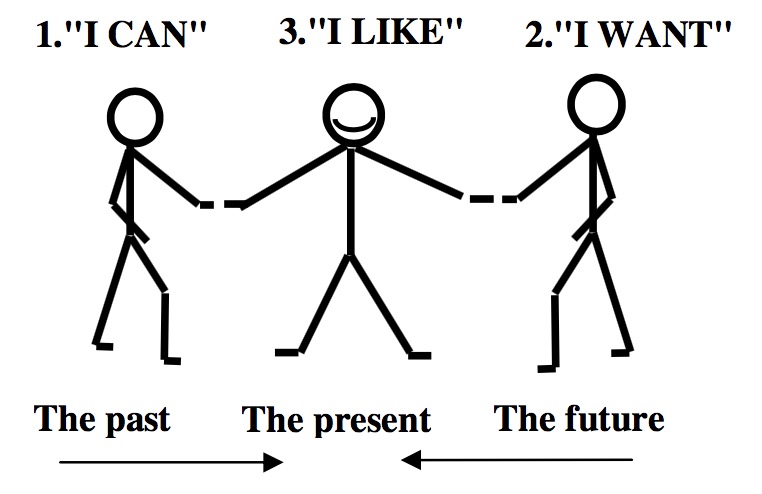
‘I can’: we are all capable of both failing and succeeding. If you believe that you can’t change, it is true; if you believe that you can, it is also true. To strengthen 'I can', think about successful changes that you have made in the past. If you can’t remember any, just consider that if others can change, you can change too.
‘I want’: you need to believe that the change is worth your time and effort. Filling in this table can help you make it clear:
| Old pattern | New pattern | ||
| Advantages | Disadvantages | Advantages | Disadvantages |
|
|
|||
However, if wanting to change is only in your head, it may not be sufficient – the resolution needs to come from your gut. A half- hearted attempt is unlikely to succeed, so make sure that you really want to make a change. The stronger and deeper the feelings associated with the change are, the more profound the change will be. The following interventions can help in this respect.
Wanting change: imagine what your life will look like (in a few days, months or years) if you continue in the same direction. Then imagine vividly that you have changed. What will it look like? How will you feel? Which one is better? Nurture a sense that you can live well without the old habit by seeing life after the change in a positive light.
‘I like’: We can learn to like and dislike something. Nobody likes their first cigarette or first glass of vodka but some persist and learn to like it. If we can learn to like what is not good for us, we can learn to like what is. We can do so by associating a change with a good experience. For example, rather than forcing yourself to eat healthily, find a way to enjoy it: prepare a nice meal and/or add to it something that you already like (e.g. bacon bits, grated cheese, good company, or nice music – be creative!). You can combine this with growing a dislike for the old habit: associate it with unpleasant feelings. 'But', you may ask, 'what can I like if I just want to give up something (e.g. smoking)?' You can like being in charge and free (from the old habit); the benefits of the new (e.g. smelling good, breathing well); the company of likeminded people; yourself, your body, your mind, your life!
The stages of change
It is widely accepted that there are several stages of change(1). Here are some suggestions for each of them:
Learn about your habit
- Its causes: to examine the causes or reasons why you have a particular habit, imagine that you no longer do what you usually do – how do you feel? How can you address the underlying feeling that causes your habit?
- Its triggers: to locate its triggers, observe your habit without any interference. A trigger can be your state of mind, other people or certain events. Consider how they can be neutralised –what else could you do in a trigger situation?
Prepare
- Set an achievable, realistic goal. Bear in mind that a small change is better than a big failure.
- If you have succeeded in making a change in the past, recall what helped you then – the same or similar may help you now.
- Your old habit may be part of a larger picture (e.g. staying out late may be a part of your social life). In this case, you may need to do something about other parts too (e.g. friends who encourage you to stay out late).
- Be prepared for the fact that some people around you may not be supportive: think about who may want (perhaps unconsciously) to sabotage the change and what you can do about it. By the same token, consider who you can talk to or rely on if you are in danger of relapsing.
- Go back to the above table that compares the old pattern and the new one, and consider how you can compensate for the advantages of the former and the disadvantages of the latter.
- Decide if you will make a change gradually or in one go.
- Consider the timing (e.g. if you are taking exams next week, it may be better to make your change after that) and set the date.
- Attempt to make a change only when you feel ready. Are you 100% ready? If you are not, go back to the prerequisites.
Go for it
- Announce your intentions and ask others to support you.
- Stop negotiating with yourself (or you will lose it). Just do it!
- Dis-identify with what needs to be changed and identify with the new (e.g. if you wish to be more outgoing, stop thinking about yourself as a shy person). You can even mentally identify with an image that symbolises the change (e.g. a rock if you want to be more firm with your choices).
Persist
Persistence is essential in this process because old patterns tend to return out of habit. This may be the hardest part (as somebody once said: ‘It's easy to stop smoking, I do it twenty times a day’). However, persevering is worthwhile: in addition to the specific benefits, every successful change also increases your sense of personal power and control. This can help you to persist:
- Use a tempting situation as a reminder to stick to your goal.
- Catch yourself when tempted, acknowledge your feelings and thoughts, and then remember the consequences of backsliding (e.g. how you will feel tomorrow).
- It is much easier to relapse when excited, so be especially vigilant if you notice that you are getting keyed up.
- Use your imagination to put yourself off a temptation (e.g. imagine slime dripping on and covering a cake you fancy).
- Enjoy the new as well as its benefits, and appreciate your achievement (no false modesty, making a change is a big deal!)
If you relapse
If you experience a relapse, accept it as a temporary setback – you are defeated only if you give up! Be aware of what is going on though, as this may help you in the future. Establish why it has happened and develop a strategy for similar situations in the future. For example, if you had a cigarette because you were annoyed, think about what you will do instead the next time you get annoyed. A frequent reason for relapse is forgetting what you have decided. So, remember to remember!
(1) Prochaska, J., Norcross, J. & Diclemente, C. (1994) Changing for Good. New York: Collins.