12. Beliefs
Man is what he believes.
Anton Chekhov (Russian 19c writer)
A belief is a mental attitude of accepting something as true, real, or existent. Beliefs underpin predictions and guide our thinking, behaviour, and decisions. They help us make sense of and navigate through life. However, rigid, fragmented or conflicting beliefs can lead to wrong choices and a host of personal and interpersonal issues. For this reason, we need to let our beliefs evolve, which is one focus of this area. As we hold many beliefs that must coexist, we also suggest how to organise them. But, of course, we need first to be clear about what we actually believe.
Uncovering hidden beliefs
Below our thoughts on the surface, there are often deeper, more general beliefs we may not be fully aware of. They are taken for granted and consequently forgotten. Yet, they shape our reactions and behaviour. Laddering is a technique that can help unearth these beliefs so that you can examine whether they still hold:
Laddering: start from any thought, asking, “Why do I think that…?” Repeat the question after each answer until an underlying belief emerges. These two points will keep you on track:
- Always ask “why do I think ..?” rather than just “why…?”, as the latter can take you astray. For instance, if you ask, “Why do I think my friend is disrespectful?” an answer might be “She is always late”; if you ask, “Why is she disrespectful?”, you may end up analysing her rather than revealing your belief.
- The subsequent questions should move from specific to more general. To continue with the above example:“Why do I think that being late means disrespect?” This is no longer about the friend specifically; it is more general. The answer may be, “I believe it is a sign that they don’t care about others”. At a point like this, you can stop with questions and examine whether that belief is sound. If not, you may let your belief evolve.
Evolving beliefs
Some of our beliefs are based on personal experiences, and others come from society (science, religion, culture). Both can be useful, but they can also be limiting. For example, failing one or two exams can make you believe that you will definitely fail the next one, or passing them without much effort, that you will certainly pass the next one. Both beliefs increase the chance of future failure. The present and the future do not need to repeat the past. Use past experiences to inform, not to form, your beliefs.
Social beliefs may also be limiting and not reflect reality well. However, because they are shared, they are less likely to cause conflicts within the community and may still contribute to harmony. Even so, if we don’t let them evolve, our personal growth may stall, meaning we won’t live life to the full and actualise all our potential. Remaining in the cocoon of beliefs may be cosy, but we don’t learn to fly. Still, whether to prioritise social harmony or development must remain a personal choice. Just to clarify, we don’t need to abandon our convictions to continue growing. Only to keep our minds open, taking a challenge to our beliefs as a potential opportunity to evolve them. This can make our conviction even stronger in the long run. The best way to do so is to aim for a good match between beliefs and reality.
Congruence
It is tempting to dismiss information and experiences that do not fit our beliefs because doing so is easier than modifying them. To avoid succumbing to this inertia, try the following: when you are about to dismiss some information or evidence offhand, imagine the opposite – that it confirms rather than invalidates your belief. Would you still dismiss it? For example, you come across research claiming that homoeopathy, which you believe in, is ineffective. If you are tempted to dismiss the research, imagine it concluded that homoeopathy is effective. Would you be equally dismissive of it? If not, it may be worth examining the research more carefully. You may initially feel some discomfort and resistance, but it will help you make better decisions and reduce conflicts.
What if there are several options and none is conclusive? You don’t need to wait for something to be 100% proven – choose the most likely option, given the available evidence.
How about if recognised facts and personal experience seem to conflict? In this case, apply reason to resolve it, and then adjust your belief accordingly. For example, you hear that the planet is getting warmer, yet you experience a cold spell in your locality. Reason can tell you that the global temperature increase doesn’t require a uniform warming everywhere, so there is, in fact, no real contradiction between the facts and your experience.
So far, we have focused on individual beliefs, but they don’t exist in isolation. Our beliefs form a system or structure that acts as an intermediary between the inner and outer world. That structure helps us hold life experiences together, which contributes to a sense of security and stability. A fragmented or conflicting belief system, by contrast, breeds anxiety. This is why it is worth doing some housekeeping to ensure our beliefs are well organised.
Organising beliefs
These principles (alongside congruence) can help keep your belief system in good shape:
Completeness: your belief system should account for all relevant facts and experiences, leaving nothing out (e.g. a belief that competition drives evolution and the economy is true but incomplete, since cooperation and collaboration also play roles).
Consistency: your beliefs should not contradict each other (e.g. rejecting a notion of free will and yet accepting a legal system based on personal responsibility may be inconsistent).
Cohesiveness: you don’t need to hold to unnecessary beliefs (e.g. believing in unicorns is not necessary to explain anything; your belief system will be complete without it). Excluding redundant elements makes the belief system more robust.
If you find it difficult to keep in mind all the facts, beliefs and their relationships relevant to a particular topic, the mind-mapping intervention can help considerably.
Mind mapping
Place the main topic (or a pivotal belief) in the centre and circle it. Then, add related facts and beliefs in other circles and use lines to make connections that are meaningful to you. The thickness of circles can indicate the importance of each element. Dotted lines can indicate weak or tentative connections; arrows can show which element influences the other; crosses can mark tension or conflict. You can be creative and use different symbols, shapes and colours. Mind-mapping can be done digitally, but using paper and pen is easier, quicker, and more fun.
Here is an example of a mind-map, clarifying what the belief in human progress may be based on:
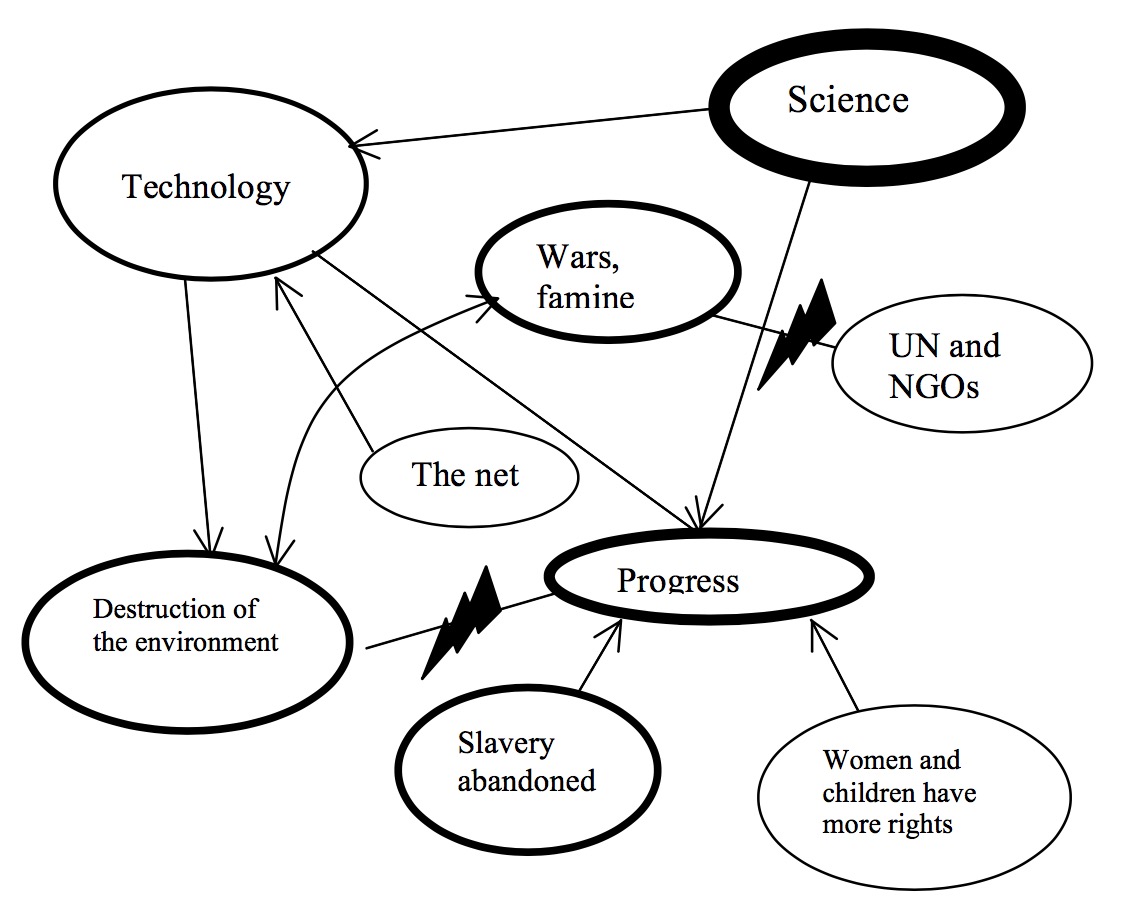
According to research, people find the invalidation of their basic beliefs highly threatening and have a vested interest in maintaining them even when they are maladaptive, fearing disorganisation[1]. Actually, evolving and organising beliefs can complement each other. Modifying or replacing some beliefs can make the inner structure more functional and satisfying, while understanding how beliefs relate to each other can motivate us to develop them.
———————————————–
[1] Epstein, S. (1993) ‘Emotion and Self-Theory’ in Lewis, M and Havilland J. (eds) Handbook of Emotions New York; London: Guilford Press, p.322