
61. Relationship Dynamic
The aim of argument, or of discussion, should not be victory, but progress.
Joseph Joubert (18c French essayist)
This area focuses on critical points in the relationship dynamic: initiating a relationship, disagreements and ending a relationship.
Initiating a relationship
Initiating a relationship can have several motives:
- Intrinsic: you like the person and enjoy being with her. To initiate a relationship though, liking needs to be mutual and genuine, rather than adulterated by, for example, a need to be liked (‘I like you, in order for you to like me back’). There are telltale signs indicating whether people like each other: they show interest in each other’s lives, they tend to smile often, and also eye contact is more frequent and maintained for longer.
- Instrumental: this motive revolves around common interests, and the possible mutual benefits of knowing each other. These benefits do not, of course, need to be material (e.g. providing information, making connections etc.). It is easier to start this sort of relationship if you balance what you can gain with what you can give and what can be shared. Being transparent with your motives builds trust, which is essential in this case.
- Intimate: showing that you are attracted to another person is not an offence, but imposing your desire is. People generally do not like to be treated as objects (of one’s sexual desire). Mature individuals do not have sex or start an intimate relationship because they are tricked or surrender to one’s advances, but because they want to. Sexual desire is natural; however, those who make it their only focus narrow and devalue themselves, which makes them less desirable – and in this case it is certainly true that our reputation precedes us.
The above may lead to three types of relationship that will be discussed in more detail in the respective areas; let’s turn now to another critical point of relationship dynamic: disagreements.
Arguments and disagreements
When a relationship is growing the chances of an argument are growing too, as the stakes are higher. An argument does not need to be a negative event though: it ‘can help maintain or even develop a relationship if it is managed right.’(1) This does not mean that fights are inevitable. In fact, fights can often lead to unsatisfactory outcomes. Research confirms that the ability to communicate effectively is essential for a successful relationship(2) – this is especially the case at the point of disagreement.
Lose, win, or win-win
In a way, resolving a disagreement is easy: just give in! This may be advisable with unimportant / short-term relationships or unimportant things (don’t sweat the small stuff). However, always giving in to avoid arguments only works temporarily and is likely to create even greater conflicts when things accumulate. On the other hand, trying to win or make the other give in does not get you far either; nobody likes to lose, so he will come back to you when he gets more ammunition. Or, you may win an argument and lose the person! Luckily, disagreements can be resolved without anybody losing: let’s call it win-win. When we aim to win, we usually use so called distributive tactics: prioritising personal interest or gains over mutual ones, looking for the faults and weaknesses of the other, using other means besides reasoning in order to gain an advantage (sarcasm, emotional blackmail, threats etc.). Win-win, on the other hand, uses integrative attitudes:
- Maintain a sense of connectedness: if you can’t feel it in the heat of an argument, imagine a thread that connects you to each other or imagine that you and the other person are in a bubble.
- Be positive: try to preserve an overall positive perception of the person even at the point of disagreement.
- Respect: remember that the other person has the right to differ.
- Be open-minded: listen and try to understand (rather than constructing your own argument while the other is talking).
- Collaborate: look for common ground, prioritise mutual interests over individual ones.
The following image illustrates the difference between distributive and integrative approaches to a disagreement:
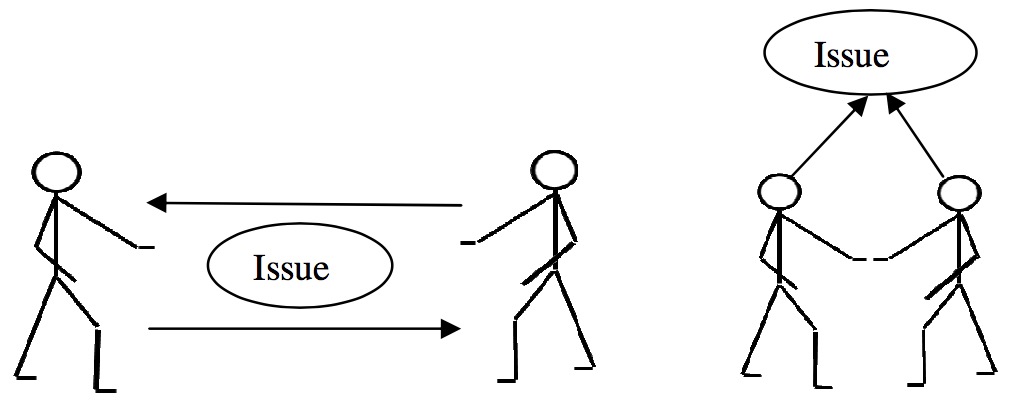
Can we always win-win? After all, one may be plain wrong! If you both come to some conclusions together, even if it means you or the other has departed from the starting position, it will not feel like a defeat, but more like personal development, learning. You can feel defeated only if you still remain in your old trench! If you have learnt something, it’s a win. You may also agree that you disagree – sometimes there are multiple perfectly valid but incompatible conclusions, as the starting assumptions may be different and there is no way to prove or disprove them. This can still be win-win as you now know each other better.
What if the other just wants to win?
Nobody can win if you refuse to fight. A fight may be fun, but it doesn’t get you very far, so do it only for fun! You can be upfront about this, saying something like, ‘I don’t feel like fighting; I’d rather get somewhere with this where we can both be happy’. This is not to say that you can’t challenge each other, but emotional or snide remarks and diversions are unhelpful; take this example: ‘We need to pay the home-help fairly.’ ‘Well, if you want to be a charity…’ – this response diverts the discussion from whether or not the home-help is paid fairly and only reveals a lack of a valid argument. Sometimes though, people do not feel like talking and would rather process the issue on their own. In such instances there is no point in forcing a discussion; it is best to let go – that is, unless it is an avoidance strategy. If talking is habitually avoided, you may need to resort to changing your attitude.
Changing your attitude
This is another way of affecting a relationship. A real change is not achieved by fantasising about what you could do and say, or by acting differently, but by shifting your perceived position in the relationship or your inner stance towards the person. The way we relate to somebody is a result of our frame of mind, so if that is changed, behavioural changes come about spontaneously. When only behaviour is changed, countless details, difficult to control consciously, will betray the real state (e.g. behaving as an equal if you feel inferior is unlikely to work).
Ending relationship (separation)
On some occasions though, whatever we do may not lead to a positive outcome and we may think about ending the relationship. Handling endings well is not easy; these two conditions can provide at least some chance of a good ending:
- An opportunity for closure: when the other person initiates the break up most of us want to know why, but when we initiate it, we’d rather avoid talking about why. We fear that the other person may pressurise us to change our mind, or that it will be ‘messy’ (crying, etc.), or that we will hurt the other if we tell them the truth. To minimise the above, offer to talk but make clear that the talk is about the closure and nothing else.
- Respect: a separation initiated only by one side may have a negative effect on the self-esteem of the other, so it is important to accompany it with showing genuine respect.
If you are thinking about ending a relationship, consider first how you would like somebody to end a relationship with you (e.g. if you would like to know why, will you too offer an explanation?).
If the other one ends the relationship without offering a chance for closure and showing respect, this shows that he is not a nice person. You can create your own closure by realising that it is actually good to end this relationship. If it bothers you that you didn’t have any say in the matter or didn’t pull the plug first, these can be signs of low self-esteem, so turn to your self-respect.
(1) Duck, S. (1991) Friends for Life. Harvester: Wheatsheaf, p.128.
(2) Sternberg, R. J. and Barnes, M. L. (1985) ‘Real and Ideal Others in Romantic Relationships: Is Four a Crowd?’ in Journal of Personality and Social Psychology, 49 (6), p.134.