57. Appearance
May the outward and the inward man be at one.
Socrates (classical Greek philosopher)
Appearance is big business nowadays. Images of public figures show how appearances are used to produce certain effects (e.g. politicians appearing in casual clothes on some occasions and in a business suit in others). This ability to create an impression is achieved through various means (clothes, make-up, posture, demeanour) and, of course, it is relevant not only for celebrities but for all of us. In this area we will focus on some basic facets that affect appearance: congruence, appeal and flexibility.
Why appearance matters
Appearance has a multiple purpose: to attract or protect; to help us situate ourselves within a certain role; to communicate mood, character, profession, position or status. So even if you don’t care about your appearance, it will still greatly affect the impression you leave. This influences the assessment and attitude of others towards you, which can, in turn, affect your interactions and self- esteem. So, let us see what really matters in this respect.
Congruence
Congruent appearance corresponds with the person, while an incongruent one does not. In other words, incongruent appearance is the result of an attempt to appear differently to who we are. This can have various motives: to trick others, to hide or protect, to preserve privacy, to compensate for a sense of personal inadequacy or inferiority, or to impress others. The aspects of appearance that are strongly emphasised may even indicate the opposite. For example, an over-jovial appearance may hide depression, or boisterous behaviour low self-esteem. There are a number of disadvantages to incongruent appearance:
- It makes you tense, creates a barrier between you and others, and is never fully satisfactory. Closeness is avoided for fear that the real person will be revealed and rejected.
- It is off-putting as it leaves an impression of being false.
- Trying to impress others with pretence also diminishes individuality and, if recognised, it may have the opposite effect from that desired. An attempt in deception is usually compensation for lacking certain qualities (e.g. a genuinely tough guy does not need to create an impression of being a tough guy); if you are not aware of it, others may well be.
- Even if you achieve a desired effect on others, it is usually temporary as it is hard to live up to created expectations, and when the discrepancy is recognised, losses are greater than any previous gains. For example, you may deceive somebody with a lot of make-up, but it won’t work in a long-term relationship.
Congruent appearance is about the match between your character, personality or inner states, and your appearance (as Socrates called for in the above quote). Congruence matters for several reasons: it is less effortful, it fosters spontaneity, you can be more relaxed and other people are more at ease as a result. Congruent appearance does not require that you are always the same in every situation. It still allows for presenting yourself in various ways, as you can choose to draw on different aspects of your character or personality. For example, your appearance may vary when you go to work and when you go out to have fun, and both can still be congruent. Or you may adjust your appearance to your mood. Creating an image is not a problem, as long as it is genuine. The following exercise can help you check if it really is.
Matching the inner and the outer: next time you get ready to go out, for example, check whether or not your appearance is congruent . Is this really you? If not, is there a good reason for you to appear different? Would incongruent appearance really help? What would happen if your appearance reflected your real self? How would that look? When doing this, don’t forget to factor in respect for others and the occasion, as this is part of yourself too.
Appeal
What makes an appearance appealing? Physical characteristics perhaps come first to mind here. No doubt that they matter, at least to begin with. However, appeal based on physical characteristics is superficial and short lived. Appeal or attractiveness is not just about physical looks. There have been many film stars for example, who haven’t been physically appealing, but their personalities or talents have shone through and they managed to win others over. There are three other factors that affect our appeal and that we can do something about:
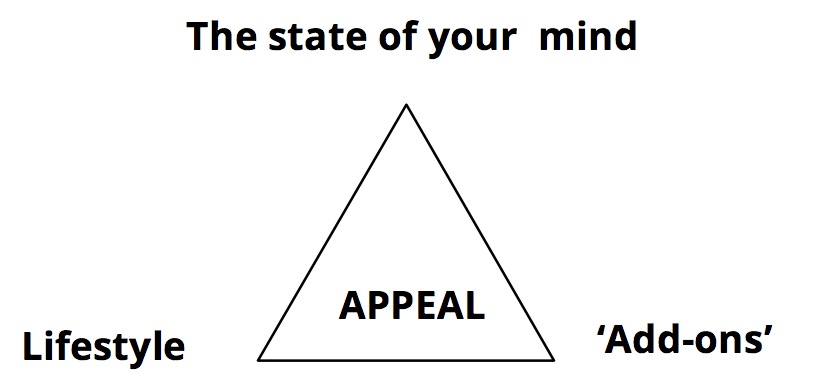
- Research confirms that ‘people who are seen as attractive are usually those with interesting or lively personalities’.(1) This is why your attractiveness varies – it depends on your state of mind at that moment. For example, insecurities about your looks can diminish your appeal more than perceived flaws. So abandon any comparisons with others, and cultivate a likeable and charming personality if you want to have appeal.
- Lifestyle (healthy diet, being physically active, good hygiene) also affects our attractiveness. Just think about one’s looks after being ‘wasted’ the night before.
- ‘Add-ons’ (make-up, clothes, jewellery, hairstyle): appeal can take different forms; rather than complying with certain standards you can create your own style in accordance with your personality. However, an appearance is always more appealing if it is harmonious. This does not imply regularity, but some coherence between what is expressed and how it is expressed, as well as between whatever ‘add-ons’ you use. Fashion is very much linked to this topic, so these reflections may be relevant at this point: does fashion matter to you? If it does matter, why is that? What messages do those who follow fashion convey? Is fashion compatible with individuality and authenticity? What are we to think about those who don’ t follow fashion? Is it hard not to follow fashion and why? Fashion persuades people to buy the new even though the old may still be okay. What effects does this have on the economy and the environment?
Flexibility
It is a good idea to be flexible with your image for several reasons:
- A fixed negative image may have a lasting effect on your sense of self-worth as well as how you relate to others.
- Being attached to even an agreeable image can be restrictive and hard work to constantly keep supporting it.
- Others can use it to control you – you may be cajoled to do something in order to be faithful to your fixed image (‘you are a nice guy, will you do it for me?’), rather than to yourself.
- An image that is useful in some situations may not be in others (e.g. a person with a fixed ‘tough guy’ image may find intimacy difficult). If you are not attached to your images, you can use and change them depending on the situation, which increases your freedom.
Playing with appearance: experiment with different appearances, first on your own (use a mirror if necessary), and then when with others. Counter fixed elements of your image by deliberately creating different ones. For instance, if you are always in jeans and sweaters, try a suit or dress (and the other way around). Or if you are timid, try to be outgoing. Register how you feel: liberated, comfortable, anxious, tense? Even if you don’t feel instantly right, give the change a fair chance. When with others though, take one step at a time and, to preserve spontaneity, analyse their reactions afterwards rather than while still with them.
(1) Duck, S. (1991) Friends for Life. Harvester: Wheatsheaf, p.45.