
29. The Present
The present which is here and now Such wise one should aspire to win What never can be lost nor shaken.
Buddha (the founder of Buddhism, 6c BCE)
This area focuses on what it really means to be present (being ‘here and now’) and why it matters. Attention and concentration will also be addressed as they are closely related to this subject.
Presence
Although we are always physically present, our mind can wander off away from the present and focus on the past, future, other places and situations, or daydream. This ability has some advantages: we can plan, process or mentally escape from what we find difficult, unpleasant or boring. However, if we make a habit of it, the result is the opposite. The very feelings we are trying to avoid (e.g. boredom) can become more intense and more frequent. But this is not all; being fully present has other benefits:
- It increases our awareness and control of the situation
- It minimises absentmindedness and clumsiness.
- It reduces stress, anxiety and worrying.
- We only really live in the present, so being ‘here and now’ enables us to live life fully.
This exercise can help us develop this ability:
Mindful presence can be practised in many situations (e.g. while doing house chores, walking or waiting). It consists of simply intending to be fully attentive to what you are experiencing or doing at that moment. Whenever you notice that you are mentally elsewhere, gently bring yourself back to the present and allow yourself to be absorbed in the here and now. To get the hang of this sort of mindfulness, start with simple, undemanding activities that we often take for granted, such as walking.
Try the above now. Get up and walk around, paying full attention to your walking, breathing and any other immediate experiences. How did you feel during and how do you feel after doing it?
Besides enhancing the sense of presence and liveliness, mindfulness usually has a calming and centring effect. Some people though feel a bit bored. If this is the case, remember that you may also feel bored with your own thinking or fantasising, so it is good to have an alternative. In this respect, mindfulness is similar to, for example, sunbathing – it may seem a bit boring at first, but in time it becomes enjoyable. Practising it regularly can also greatly improve your attention and concentration. In fact, it is wise to be mindufl even with what may seem unimportant – or otherwse, it may become important (such as where you left your keys).
Larger perspective
Being in the present is important, but this is not to say that we should always reduce our mental life to only immediate experiences. Presence shouldn’t mean being stuck in the present. A larger perspective that may involve recalling past experiences, planning, thinking about other people or what is going on elsewhere, as well as future consequences of present actions, may sometimes matter more. Real mastery is being able to be fully present and yet keep in mind that all-encompassing larger perspective. The following exercises can help you achieve this.
On the top of a mountain: close your eyes and imagine that you are standing on the top of a mountain. This very top is the present moment. Behind you is your past; in front of you is your future; on one side things happening elsewhere; on the other are your fantasies and other thoughts. So, you can see (keep in mind) all of them and yet remain in the present – on the top of the mountain.
Once you get a feel of it, this could become your default position. Let’s now turn to attention and concentration – essential qualities if you want to do something well, from playing sports to studying.
Attention
Attention means focusing our awareness. It does not only help us gather information about something quickly and accurately, but it can also release awareness from other unimportant or undesirable contents (such as worries or background chatter). All that we have covered so far can already help develop attention, so we will go a step further here and take up its dynamic properties – the ability to zoom in and zoom out. Sometimes we need to focus on something very specific and be able to exclude everything else (e.g. when we read something). In other situations, we may need to pay attention to many things simultaneously (e.g. when playing football or when cooking). So being flexible and able to narrow and expand our awareness at will can come in handy. The following exercise is a kind of workout for developing this mental muscle.
Awareness control consists of three steps:
- Choose a small object. It could be anything, a cup, a leaf, your own hand, etc. Focus on it, observe, touch, hold, smell it. You will probably notice some details that you have not been aware of before (even if it is a very familiar object) relating to shape, colour, structure, texture etc. If your mind wanders off, bring your focus gently back to the object, as long as you find that your awareness is being enriched.
- This step is opposite to the previous one. Try to expand your awareness and become aware of as many sensations as possible at the same time (not only visual, include other senses too).
- Finally, try to combine these two. Focus first on one object, then expand your awareness as much as possible, and then focus your awareness again.
With some practice, you will be able to contract and expand your awareness at will, which can substantially improve your attention.
Concentration
Concentration is the ability to maintain focus on the object of attention. Factors that contribute to concentration are:
- Good rest
- Motivation and interest
- Some peace: external peace requires minimising distractions (e.g. phone ringing), while internal peace requires minimising inner conflicts (such as a wish to be doing something else).
Trying too hard doesn’t work (if you keep thinking that you have to concentrate, you are not concentrating on the subject); just allow yourself to be drawn into something instead. The following exercise can help with concentration:
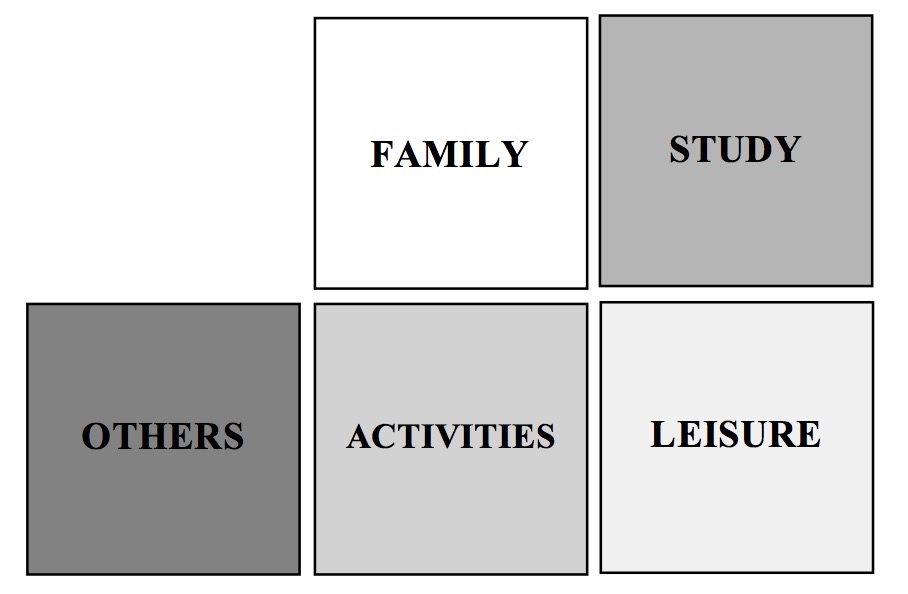
Life house: imagine that your life is a house with a few rooms (e.g. work, family, leisure, friends etc.). You can draw a picture of it, if you wish, and paint each room in a different colour or make it unique in some other way. This is a very simple drawing, as an example:
When you need to concentrate, remember the picture, imagine that you are in the appropriate room, and close the doors to other rooms. This can help you focus, avoid unwanted interferences, and have a break from the rest.
When we have done what we need to on the inside, the outworking will come about automatically.
Goethe (18/19c German writer and statesman)
This area is not about changing your job, wallpaper, country or partner – it is about changing yourself; in other words, your habitual cognitive, emotional and behavioural patterns.
What do you want to change?
Being able to make a personal change is essential. So this chapter will be very practical and to get the most out of it, it may be a good idea to start by thinking about something that you would like to change. Choose something small because this increases your chances of success and confidence. Define what you want to achieve in simple, clear and positive terms (for example, rather than aiming to lose weight, aim to be fit or to look good).
Prerequisites for successful change
‘I can’, ‘I want’ and ‘I like’ are three conditions for successful change. If all three are present, you can hardly fail!

‘I can’: we are all capable of both failing and succeeding. If you believe that you can’t change, it is true; if you believe that you can, it is also true. To strengthen 'I can', think about successful changes that you have made in the past. If you can’t remember any, just consider that if others can change, you can change too.
‘I want’: you need to believe that the change is worth your time and effort. Filling in this table can help you make it clear:
| Old pattern | New pattern | ||
| Advantages | Disadvantages | Advantages | Disadvantages |
|
|
|||
However, if wanting to change is only in your head, it may not be sufficient – the resolution needs to come from your gut. A half- hearted attempt is unlikely to succeed, so make sure that you really want to make a change. The stronger and deeper the feelings associated with the change are, the more profound the change will be. The following interventions can help in this respect.
Wanting change: imagine what your life will look like (in a few days, months or years) if you continue in the same direction. Then imagine vividly that you have changed. What will it look like? How will you feel? Which one is better? Nurture a sense that you can live well without the old habit by seeing life after the change in a positive light.
‘I like’: We can learn to like and dislike something. Nobody likes their first cigarette or first glass of vodka but some persist and learn to like it. If we can learn to like what is not good for us, we can learn to like what is. We can do so by associating a change with a good experience. For example, rather than forcing yourself to eat healthily, find a way to enjoy it: prepare a nice meal and/or add to it something that you already like (e.g. bacon bits, grated cheese, good company, or nice music – be creative!). You can combine this with growing a dislike for the old habit: associate it with unpleasant feelings. 'But', you may ask, 'what can I like if I just want to give up something (e.g. smoking)?' You can like being in charge and free (from the old habit); the benefits of the new (e.g. smelling good, breathing well); the company of likeminded people; yourself, your body, your mind, your life!
The stages of change
It is widely accepted that there are several stages of change(1). Here are some suggestions for each of them:
Learn about your habit
- Its causes: to examine the causes or reasons why you have a particular habit, imagine that you no longer do what you usually do – how do you feel? How can you address the underlying feeling that causes your habit?
- Its triggers: to locate its triggers, observe your habit without any interference. A trigger can be your state of mind, other people or certain events. Consider how they can be neutralised –what else could you do in a trigger situation?
Prepare
- Set an achievable, realistic goal. Bear in mind that a small change is better than a big failure.
- If you have succeeded in making a change in the past, recall what helped you then – the same or similar may help you now.
- Your old habit may be part of a larger picture (e.g. staying out late may be a part of your social life). In this case, you may need to do something about other parts too (e.g. friends who encourage you to stay out late).
- Be prepared for the fact that some people around you may not be supportive: think about who may want (perhaps unconsciously) to sabotage the change and what you can do about it. By the same token, consider who you can talk to or rely on if you are in danger of relapsing.
- Go back to the above table that compares the old pattern and the new one, and consider how you can compensate for the advantages of the former and the disadvantages of the latter.
- Decide if you will make a change gradually or in one go.
- Consider the timing (e.g. if you are taking exams next week, it may be better to make your change after that) and set the date.
- Attempt to make a change only when you feel ready. Are you 100% ready? If you are not, go back to the prerequisites.
Go for it
- Announce your intentions and ask others to support you.
- Stop negotiating with yourself (or you will lose it). Just do it!
- Dis-identify with what needs to be changed and identify with the new (e.g. if you wish to be more outgoing, stop thinking about yourself as a shy person). You can even mentally identify with an image that symbolises the change (e.g. a rock if you want to be more firm with your choices).
Persist
Persistence is essential in this process because old patterns tend to return out of habit. This may be the hardest part (as somebody once said: ‘It's easy to stop smoking, I do it twenty times a day’). However, persevering is worthwhile: in addition to the specific benefits, every successful change also increases your sense of personal power and control. This can help you to persist:
- Use a tempting situation as a reminder to stick to your goal.
- Catch yourself when tempted, acknowledge your feelings and thoughts, and then remember the consequences of backsliding (e.g. how you will feel tomorrow).
- It is much easier to relapse when excited, so be especially vigilant if you notice that you are getting keyed up.
- Use your imagination to put yourself off a temptation (e.g. imagine slime dripping on and covering a cake you fancy).
- Enjoy the new as well as its benefits, and appreciate your achievement (no false modesty, making a change is a big deal!)
If you relapse
If you experience a relapse, accept it as a temporary setback – you are defeated only if you give up! Be aware of what is going on though, as this may help you in the future. Establish why it has happened and develop a strategy for similar situations in the future. For example, if you had a cigarette because you were annoyed, think about what you will do instead the next time you get annoyed. A frequent reason for relapse is forgetting what you have decided. So, remember to remember!
(1) Prochaska, J., Norcross, J. & Diclemente, C. (1994) Changing for Good. New York: Collins.