
4. Self-valuation
Tho’ modesty be a virtue, bashfulness is a vice.
Benjamin Franklin (a Founding Father of the US)
There are two types of self-value: acquired and innate. The former is linked to self-esteem, and the latter to self-respect. Self-esteem feels good when high, but it can also be so low that we feel as if we are falling into an endless pit. This is why it is important to have something to hold onto in these situations, something that does not depend on our successes, or the way we look, or how others see us. This is self-respect. In this area, we will examine and discuss both self-esteem and self-respect.
Self-esteem
What is self-esteem? To esteem anything is to evaluate it (as in ‘estimate’); so, self-esteem is about evaluating or judging ourselves. When we have high self-esteem, we think well of ourselves, and we hold ourselves in high regard. Conversely, having low self-esteem means not thinking highly of oneself. Self-esteem has much to do with personal achievement and success, but it also depends on our expectations. If our realisations exceed our expectations, we will have high self-esteem; if our expectations are greater than our achievements, we will have low self-esteem. For example, if you don’t expect to win a medal at the Olympic Games but actually win bronze, your self-esteem will be high. If you expect to win gold but end up winning silver, your self-esteem will be low, even though you objectively achieved more than in the first case. So, higher self-esteem can be brought about either by achieving more or by lowering our expectations.
The effects: self-esteem influences how we feel about ourselves. Research indicates that people with high self-esteem are happier and more effective; they are also likely to be more assertive, independent, and creative.4 However, as we all probably know, there is also a flip side to this, to which we will turn now.
The flip side of self-esteem
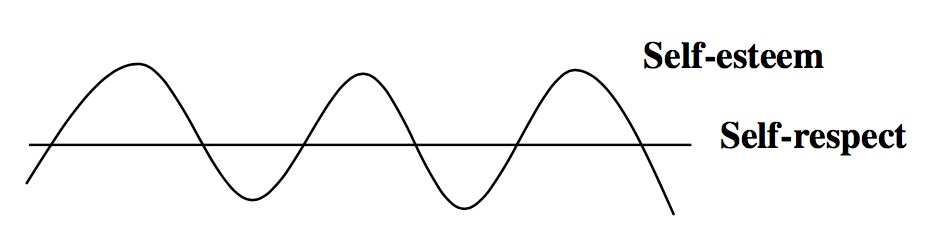
Since self-esteem depends on achievement and often requires recognition from others, it is never completely secure and needs frequent affirmation. Yet it is hardly possible to always meet or exceed our own and others’ expectations. As a result, it is inevitable to experience dips in self-esteem. Such fluctuations may happen several times in a single day, hence the phrase ‘the rollercoaster of self-esteem’. Naturally, this can have an unsettling effect on our moods and undermine our confidence. Even if we manage to sustain high self-esteem for a while, we may experience some side effects.
First, it can foster self-satisfaction that reduces motivation to grow or improve. When we feel we have already “arrived,” the drive for further development may quietly diminish.
Second, with hardly noticing, we can develop an inflated sense of self-importance, even conceit and vanity. This happens when esteemed value (what sets us apart from others) is prioritised over innate value (what we share with others). In other words, when self-image is more valued than the self. Ironically, this can erode our sense of self-worth. If we believe that our worth depends on being good-looking, successful, popular, or rich, we implicitly believe we are worthless without these things. We fear that if we can’t sustain them, we will be left with nothing. So, we are compelled to keep up, which becomes a vicious circle.
Third, chasing high self-esteem can also alienate others. Especially when based on competition and comparison (an unspoken “I am better than you”), it often comes at the expense of others, which, naturally, others may resent.
Lastly, because self-esteem can produce an emotional ‘high’, we can get attached – even addicted to it. However, this feeling never lasts long, so high self-esteem needs to be constantly reinforced, which can be exhausting.
In short, high self-esteem can make us feel good, but there may be something better in the long term than riding this rollercoaster.
Self-respect
Self-respect is about our innate value and does not depend on our merits or successes. So what is it about us that is worthy of respect, no matter what? Actually, three things: we are the most complex thing in the known universe (our brain has more cells than there are stars in our galaxy); each person is unique, so there is nobody like you; unlike computers or other machines we have a capacity to make our own choices and act upon them. This complexity, uniqueness and potential (arising from our ability to make choices) are worth respect, even if there is nothing else. After all, they are expressions of what is most precious to all of us: our existence and our agency (freedom, if you wish). A lack of self-respect affects confidence and a general sense of well-being. Moreover, if you don’t respect yourself, it is less likely that others will. So what does self-respect mean in practice? Essentially, it means taking yourself (rather than your image) seriously, coupled with self-compassion. Self-compassion doesn’t mean being soppy about yourself, but feeling respect. Let’s try it.
Self-compassion meditation: close your eyes and relax. Imagine watching yourself without any judgements, positive or negative. If you manage to do so, you won’t feel anything – you will feel compassion that arises simply from awareness that you are alive and that you can choose what to do.
Modesty is closely linked to self-respect, because people who truly respect themselves do not need an ego-boost. Modesty is different from self-deprecation or submissiveness though. Giving inflated importance to others or always positioning yourself below them can only be a sign of false modesty. A modest person simply does not base her value on comparison with others and is not concerned with enhancing her self-image and gaining admiration. This is why secondary gains, such as praise or fame, lose their importance. Being modest is beneficial in many ways: it preserves energy, improves relationships, and reduces self-centeredness, which enables the person to experience the world more fully.
Self-esteem and self-respect compared
Self-esteem and self-respect may seem similar, but there are important differences between them. Let’s take the example of people singing at a celebration or party: those with a strong sense of self-respect are trying to do their best, but are essentially enjoying themselves even if they are not very good at singing. Those who emphasise self-esteem would weigh themselves against others and not really enjoy singing if they don’t do well in comparison. Since self-respect is based on innate value, comparison or competition with others is less important. Such an attitude doesn’t undermine achievements, but values them for their own sake, rather than as a means to maintain a sense of personal worth. Even compared to those who have high self-esteem, those with self-respect are less prone to self-blame, guilt, regret and stress. Moreover, since self-respect does not depend on judgements (our own and of others), it is more stable than self- esteem and may be the key to achieving peace of mind.
This exercise can help you determine if you emphasise self-esteem or self-respect:
Self-characterisation: write a few lines about something you have done well and about something you haven’t, when you have failed in your own eyes. After you finish, consider if your feelings and / or the tone and style of your writing change significantly from one case to the other. If they do, it is likely that your emphasis is on self-esteem. If your feelings and style don’t change much, self-respect is probably more important for you. This is because a more even perspective on successes and setbacks indicates a stable sense of self-value underpinning all of them.