
9. Learning
The purpose of learning is growth, and our minds, unlike our bodies, can continue growing as we continue to live.
Mortimer Adler (20c philosopher)
Learning is so important that we are all born with a love for learning. You don’t need to nudge babies to learn; they naturally enjoy it! However, this urge may be distorted over time, like our eating habits – we don’t always learn what is good for us, but learn junk instead. So let’s see how we can keep the flame of love for learning alight and get the most out of it. We start by considering various learning types and conclude this area with some mnemonic techniques to improve memory.
Learning types
There are four learning types:
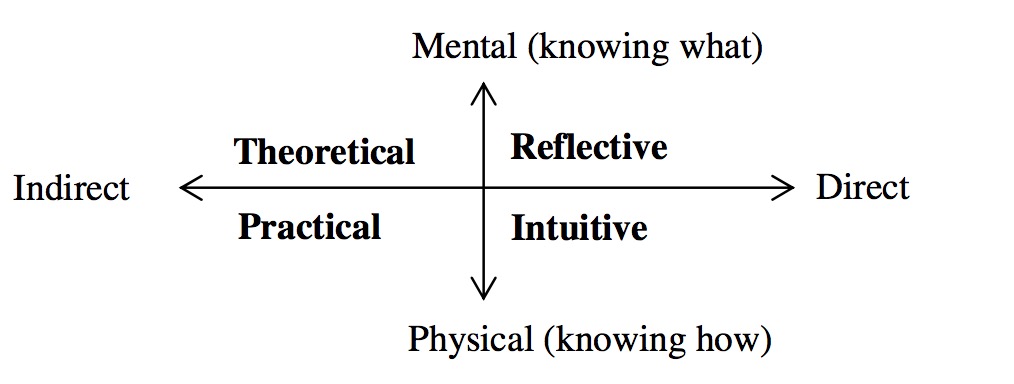
Theoretical learning is indirect cognitive learning. Indirect means that you learn from materials or others. What distinguishes this type from just memorising is understanding, which requires:
- An enquiring mind, curiosity, interest in the subject
- Proactive engagement (questioning, clarifying, debating)
- Making connections between elements of what you are learning about and also with what you already know.
Reflective learning is direct cognitive learning based on your own thinking and personal experience. For example, you can stop reading to reflect on what you just read. It requires solitude, but can be done while showering, walking, or doing house chores.
Practical learning is indirect, kinaesthetic learning. You learn to do something from others or manuals (e.g. learning to drive). It is most useful when knowledge gained this way becomes mainly unconscious and instinctive. This is achieved through practising.
Intuitive learning is direct kinaesthetic learning – by trial and error. Learning how to ride a bike is an example. Of course, others can help you and encourage you while you are doing so, but you have to keep trying until you get the knack of it.
None of these styles is superior. In fact, they are often combined, and in some situations, you may need all four. For example, in social occasions, theoretical learning can help you be informative, intuitive to be spontaneous, practical to demonstrate politeness, and reflective to be interesting. It can sometimes even be dangerous not to combine them (e.g. learning how to use a gun may be unsafe if you don’t know how to control your impulses or do not reflect on possible consequences). Considering that they all matter, it is a good idea to balance them: try more often those you use least. For that, you need to find a way to like them.
Uplift learning
This exercise can connect you with the innate drive to learn. Use it whenever your motivation to learn is low.
Recall situations when you have enjoyed learning (e.g. swimming or playing a game; a new school subject; something interesting from the net or a book; insights you have gained from discussions or your own thinking). Try to recapture as best as you can that feeling. When you get to the point of experiencing it fully, turn to what you are about to learn now. This intervention works better if what you remember and what you want to learn are of the same type (e.g. if you want to motivate yourself to acquire a new skill through instruction and practice, recall when you enjoy learning in that way previously).
Learning tips
- If you are interested, learning is easy – so the top tip is to get curious and interested in the subject.
- Understand or master the basics. This allows you to build on the solid foundations. So, first lessons are the most important.
- Make gradual, incremental steps without big leaps and try to connect the new to what you already know.
- Make a link between what you are learning and your own experience (e.g. link physics to skateboarding, sailing or golf).
- Imagine what you are learning (Einstein created the theory of relativity from imagining that he was riding a beam of light).
- Summarise a long text to a few sentences or bullet points.
- Draw a diagram or a picture of what you want to remember.
- Try to explain or imagine that you are explaining what you have learnt to somebody else (this also increases motivation).
Retention
- These suggestions can help you remember what you have learned:
- Forget what you don’t need to remember. If we cram our heads with unimportant information, it should not come as a surprise that we can’t remember what really matters.
- Retention is better when information is related to personal experience and when it is meaningful. The latter involves either understanding an already implied meaning or deliberately connecting various elements in a meaningful way (see below).
- Feelings and sensations have the deepest impact on memory, followed by images, and finally by abstractions and symbols (e.g., words). So, abstract information is easier to remember if it is connected to a feeling, sensation or image. For example, a scent may assist your memory if it is present during learning and at the time of recall (e.g. at an exam). Using the same in unrelated situations will decrease its effectiveness, though.
- Research also indicates that retention is better if the context at recall matches the context at learning (e.g. if you recall information in the same room in which you learned it).[i]
- Try to remember getting things right, rather than failures.
[i] See, for example, Matlin, M. (1983) Cognition. London: Holt, p.85.
Mnemonic techniques
Mnemonic techniques are usually used to remember names, lists of items, or numbers. They can be grouped into two categories: one based on visualisation and the other on meaning-making:
Visualisation
- Associate a name you want to remember with an image of a similar word. So if you want to remember the capital of Australia (Canberra) imagine a slice of Camembert cheese sitting on a map of Australia; if you are introduced to somebody called Rosie, imagine her wearing a hat with roses.
- Imagine your house or flat. Place each item you want to remember in different parts of your house (e.g. the hall, staircase, bathroom, living room, etc.). Then, imagine walking through it when you try to remember them.
- Associate each number to be remembered with an image (e.g. 1 = street lamp, 2 = swan, 3 = flying bird, etc.) and then create a picture or clip from these images (e.g. 231 = a swan makes a bird fly off and hit a street lamp).
Meaning
- Create a story that includes all the items to remember.
- To memorise the spelling of a word, for example, create a sentence out of words that start with letters that make up that word (e.g. because – Big Elephants Can Always Upset Small Elephants).
- Make a meaningful sentence out of the items you want to remember or their first letters. For example, the order of the first three colours in snooker (the most difficult to remember): God Bless You – Green, Brown, Yellow
The order of operations for maths is: Parentheses Exponents Multiply Divide Add Subtract – Please Excuse My Dear Aunt Sally
(1) See, for example, Matlin, M. (1983) Cognition. London: Holt, p.85.